

























































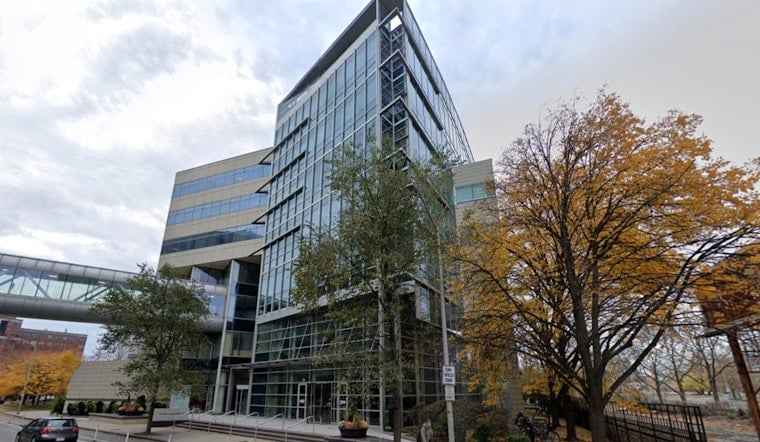
Draper has bought back four floors of laboratory condominiums inside its own longtime Kendall Square home, paying $45 million for space that Alexandria Real Estate Equities purchased for $120 million just four years earlier. The deal covers units on the fifth, sixth, and seventh floors of 1 Hampshire St., a seven-story, 105,000-square-foot building the nonprofit engineering research organization calls the Albert G. Hill Building, named after Draper's first chairman.
The sale, first reported by Bisnow, represents a 62.5% price drop from what Alexandria paid to acquire the condo units from Schlumberger Ltd. in June 2022, marking a $75 million loss on the asset. Alexandria announced its intent to sell its portion of the property in the fourth quarter of 2025, and the company did not respond to Bisnow's request for comment on the transaction. Draper has occupied the building since 1984 and is headquartered directly across the street at 555 Technology Square.
A Steep Discount Reflects a Cooling Lab Market
The write-down lands amid a broader reset in Greater Boston's life sciences real estate. The region's lab vacancy rate hit 28.7% in the second quarter of 2026, with total availability climbing to 32.8%, according to CBRE. That oversupply has pushed institutional landlords to shed properties that fall outside their core holdings rather than wait for lab demand to recover.
Alexandria has targeted $2.9 billion in total asset dispositions for 2026 as part of a strategic shift to reduce non-core property exposure amid a multi-year biotech market correction, according to Seeking Alpha. The 1 Hampshire St. sale fits a pattern the company has followed since 2023, when it sold more than $1 billion in Greater Boston assets, and continued in 2024 with a $306 million divestment of Cambridgeport and Waltham properties to Phase 3 Real Estate Partners, according to Banker & Tradesman. Even after those sales, Alexandria still owns roughly 9.3 million square feet across Greater Boston, including 4.7 million square feet in Kendall Square alone, with 566,000 square feet currently under development.
Draper's Deep Roots in the Building
Draper's connection to 1 Hampshire St. long predates this purchase. The organization already owned space on the building's lower floors before this deal, while Schlumberger Ltd. holds the first and second floors. Draper traces its own history back to 1932 as the MIT Instrumentation Laboratory before spinning off as an independent nonprofit R&D corporation in 1973 and relocating its headquarters to Technology Square in 1975, according to Wikipedia. Alexandria itself built its Kendall Square footprint in 2006 by acquiring the adjacent 1.2 million-square-foot Technology Square campus from MIT for $600 million.
Draper has continued investing in its Cambridge campus over the years, breaking ground on a $60 million, 20,000-square-foot lab addition at Technology Square in 2016. The organization now maintains national offices in Utah, Texas, Indiana, Alabama, Florida, Virginia, and Washington, D.C., along with local offices in Pittsfield and Bedford.
Tough Tech Fills the Vacuum Left by Biotech
The purchase also reflects a shift in who is actually leasing and buying lab space across the region. Non-biotech “tough tech” companies — including defense, robotics, microelectronics, and AI hardware entities like Draper — accounted for 30% of Boston-area lab leasing activity in 2025, tripling their market share from four years earlier as landlords court nontraditional tenants. Draper is deploying capital elsewhere in the state, too: the organization broke ground in April on a $100 million, 75,000-square-foot microelectronics facility tied to the University of Massachusetts Lowell, backed by $25 million in state and local economic development funds secured in 2025 — a project Hoodline covered as it advanced through municipal and state approvals.
Not every corner of the market is contracting equally. The Cambridge submarket posted nearly 194,000 square feet of positive net lab absorption in the second quarter of 2026, leading Greater Boston's stabilization even as suburban submarkets shrank further, per CBRE. That resilience contrasts with the national construction pipeline, which fell to just 6 million square feet of new lab space in 2026 — the lowest level since 2019 and a steep drop from more than 37 million square feet at the 2023 peak.




